

Café · Los Angeles · ⭐ 9.1/10 · 715 reviews · updated: 2026-08-10 15:37:19
Address: 500 Mateo St #102, Los Angeles, CA 90013, United States
Almost every café on this list buys its coffee from somewhere else. Verve Coffee Roasters built the somewhere else, and then wrapped a café around it. The Arts District flagship is a working production roastery with a hundred-seat room arranged around the machine, and the company that owns it began as two friends roasting on the surf coast far north of here. It is the largest and most ambitious specialty coffee address downtown, and it has never pretended to be a neighborhood hole in the wall.
Highlights
- A production roastery you sit inside — the room is built around a large roasting machine, so the coffee in your cup and the coffee going into bags for the rest of the city come off the same floor.
- Founded in Santa Cruz in 2007 — two friends started it in a surf neighborhood on the central California coast, and the company is still independently owned rather than folded into a group.
- A draft bar with eighteen taps — nitro and flash-brewed coffee handled the way a brewery handles beer, including infusions poured only at this address.
- Farmlevel — the house direct-trade program, which pays premiums at origin and brings producers from different countries into the same room; the first of its summits was hosted in this building.
- Roaster of the Year — the American roasting trade magazine gave the company its 2024 title in the large-producer category, which is the industry judging the industry rather than a marketing line.
- Built for a long stay — well over a hundred seats, a dog-friendly patio, a cupping room and a training lab, in a district where most coffee bars amount to a counter and six stools.
What’s in the cup
This is one of the few rooms in Los Angeles where the question “who roasts this?” has the shortest possible answer: the people standing behind the counter, in the machine you can see from your table. The Arts District building is a genuine production site rather than a decorative roaster parked in a window for atmosphere — it is the company’s second California base, and green coffee arrives here to be roasted for the southern half of the state while the original operation continues on the coast up north. The practical consequence is freshness and control: the bar can pull espresso from a coffee that was roasted a few paces away, and the retail shelf is stocked from the same batches rather than from a distribution center.
The sourcing behind that is the part the company is proudest of, and it has a name. Farmlevel is Verve’s direct-trade framework: relationships with individual producers instead of anonymous lots, premiums paid for quality rather than for certification alone, and money put back into the places the coffee comes from. It began with a specific problem. When leaf rust swept through Central American farms in the early 2010s, one of the founders spent a long stretch traveling through affected regions and concluded that the growers had more to teach each other than any buyer could teach them. The idea that came out of that became a recurring summit that flies producers from different countries in to compare notes — and the first one was held in this building, which tells you what the space is actually for.
In the cup, the range is deliberately wide. There is espresso built to work in milk for the majority who order it that way, there are single origins for the people who want to taste a farm rather than a house style, and there is a blend created specifically for the opening of this address and named after the block it stands on, now poured across the company’s cafés in the city. Filter is taken seriously and made to order rather than kept warm in a jug.
Then there is the tap wall, which is where this place stops behaving like a normal café. Eighteen taps run cold coffee the way a brewery runs beer: nitrogen-poured cold brew with the texture that gives it, flash-chilled brews that keep the aromatics a slow steep loses, and infusions invented here and available nowhere else in the company. It is a genuine innovation program rather than a novelty — the same building houses a test kitchen and a beverage development bench — and it means the summer version of this café is completely different from the winter one.
Who’s behind it
Verve was started in 2007 by two friends, Colby Barr and Ryan O’Donovan, in a surf neighborhood on the edge of Santa Cruz, several hours up the coast from Los Angeles. The company grew steadily rather than explosively, kept its independence, and stayed a roasting business first and a café business second — which is the opposite of how most café groups develop, and it explains the shape of this address.
By the time the Arts District opened its doors in the late 2010s it was the company’s fourteenth retail location and its second headquarters, and the founders described it publicly as a home for the Los Angeles side of the operation rather than as another shop. That framing is honest. Almost everything in the building that is not a table exists to make coffee better somewhere else: the cupping room where lots are evaluated, the training lab where staff are taught, the test kitchen, the event space where the producer summit was held. The café is the public face of a workshop.
The industry has noticed. In 2024 the American trade magazine that judges roasting companies named Verve its Roaster of the Year in the large-producer category, citing both the coffee and the way the company treats the people along its supply chain. That is a peer judgment rather than a customer one, and it is the strongest single argument for why this address deserves a place on a list of the city’s cafés.
What it’s for
Start with the obvious one: this is a working room. It is among the very few coffee bars downtown with enough seats that opening a laptop does not feel like taking someone’s table hostage, and the layout gives you a choice of postures — a long communal surface, small tables, the bar, the patio. The house does not advertise a wall of outlets, so the sensible plan is to arrive charged and treat a socket as luck rather than as the reason you came. Nobody hurries you, but the room fills hard at the weekend brunch peak, and at that hour a single cup and a four-hour session is bad manners rather than bad luck.
The second scenario is the meeting, and it is what the space does best. The scale means you can talk without your neighbor hearing everything, the food menu means a meeting can turn into a meal without moving, and the neighborhood makes it a natural midpoint between downtown offices and the studios east of the river. Creative-industry meetings are visibly a large part of the daytime traffic here.
The third is the coffee visit proper: come to the counter, ask what is on filter, taste something you cannot get elsewhere off the tap wall, take a bag home. For anyone who actually cares about roasting, this is the address in Los Angeles where the staff can answer questions in real depth, because the roastery is behind them and the training lab is upstairs from the conversation.
The fourth is the one people underrate: a group with mixed appetites. A table of four where one wants brunch, one wants an espresso, one wants something cold and elaborate and one wants none of the above is a problem in most specialty bars and no problem at all here.
The space
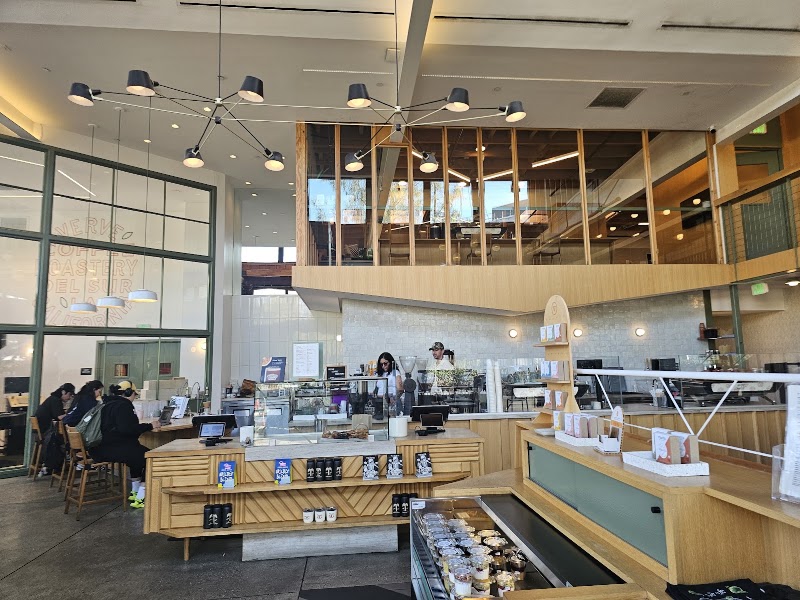
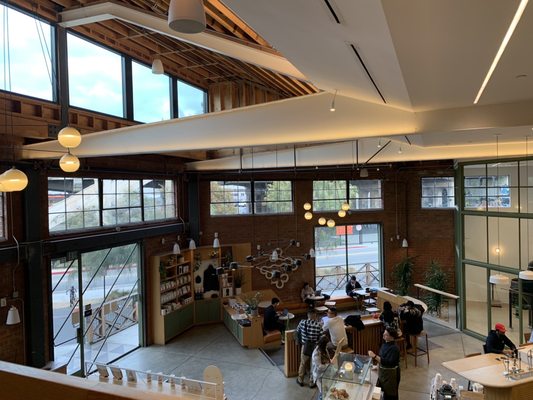
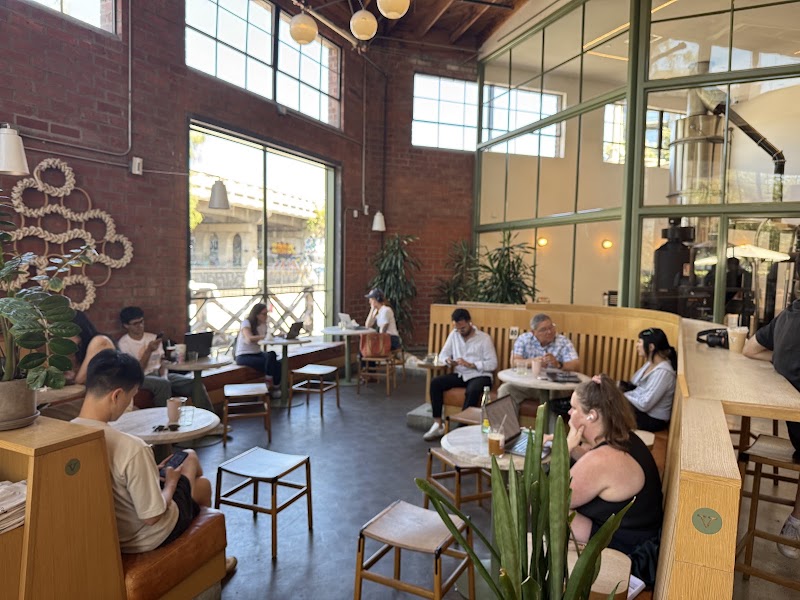
Seven thousand square feet, which in café terms is enormous, and a room designed to feel airy rather than industrial despite the machinery in the middle of it. A Los Angeles architecture practice known for playful, light-filled interiors did the design, and a landscape studio filled it with plants — the effect is blonde wood, tall windows, greenery and a lot of natural light, closer to a Nordic room than to the black-walled warehouse aesthetic the Arts District usually reaches for.
The roaster is the centerpiece and everything orbits it, which gives the space its particular smell and its particular soundtrack: on a roasting day the noise of the drum and the cooling tray is part of the room. That is charming to most people and distracting to a few, and it is worth knowing before you settle in for concentrated work.
Outside there is a patio, which is dog-friendly and which most regulars treat as the better seat whenever the weather cooperates — in this city, most of the year. Inside, the room is loud at peak simply because of the number of people in it; at quiet hours it is one of the calmest large spaces downtown. The seating count runs well past a hundred, so unlike almost every other café on this list, the answer to “will we get a table?” is usually yes.
Beyond coffee
The kitchen is real and it is staffed properly. When the flagship opened, the company hired an executive chef with a Michelin-kitchen background and a competition-television win behind him to build a full breakfast and lunch menu — Californian in its produce, light on ceremony, with a running joke of a house style where coffee turns up inside the food as well as beside it. This is not a pastry case with a panini press next to it; it is a genuine daytime menu with vegetarian and vegan options treated as first-class rather than as concessions.
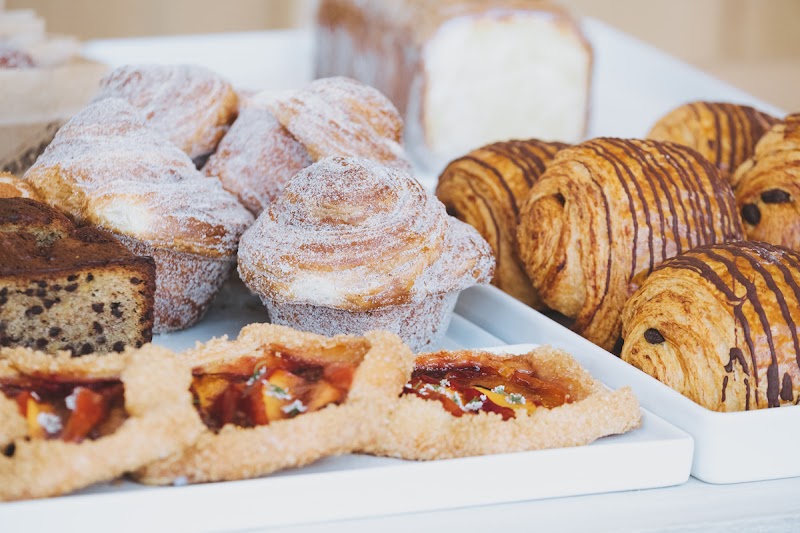
On the baking question, the house is straightforward: bread and pastries are not made in this building. They are bought in from two well-known Los Angeles bakeries, one of them a specialist in gluten-free and allergy-friendly baking, which is unusually useful information for anyone who normally has to interrogate a counter before ordering. Buying in from good bakers rather than running a mediocre oven is a defensible choice, and the company does not hide it.
The non-coffee drinks deserve their own mention because the tap wall is not coffee-only. The same development bench that invents cold coffee also works on other cold drinks, and the bar treats them with the same seriousness — which makes this one of the better addresses in the district for someone who does not drink coffee but does not want to be handed a bottle of juice as an afterthought.
When to come
The doors open early enough for a pre-work stop, and that first stretch is the best of the day if you want the room quiet, the light long across the floor and the counter free to talk. Mid-morning on a weekday is the working peak — busy but functional, most tables occupied by people typing. Early afternoon is the softest hour and the one to choose for a conversation.
The weekend is a different café entirely. The Arts District fills with visitors, the brunch trade arrives, the patio goes first and the room reaches full capacity; come for the atmosphere rather than for work, and expect to wait for the seat you want. The building closes earlier than the restaurants around it, so treat it as a daytime address and let the neighborhood handle the evening.
Getting there
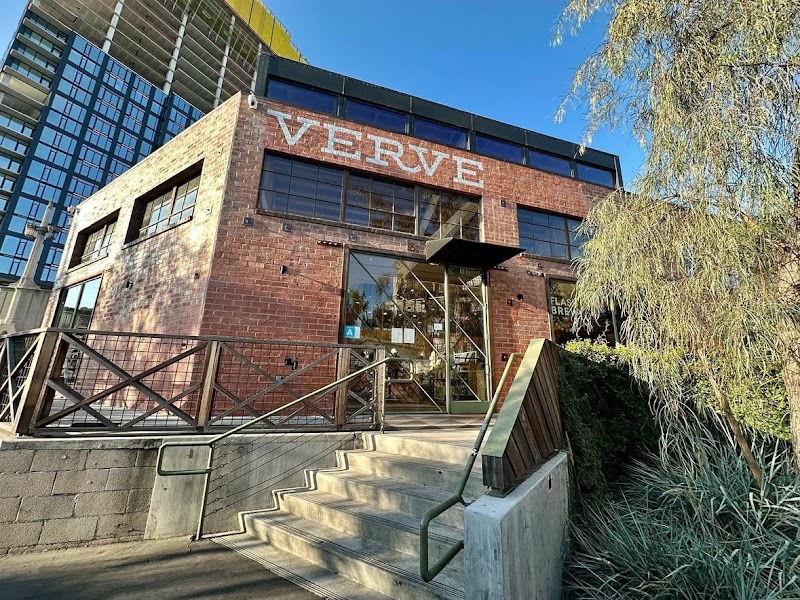
The café sits in the Arts District, in the belt of converted warehouses east of Little Tokyo, close to the bridges that cross the river and immediately next to one of the most celebrated Middle Eastern restaurants in the country — which is the landmark most locals will use if you ask for directions. Coming by rail, the Little Tokyo/Arts District station puts you about fifteen minutes away on foot, through warehouse blocks that are pleasant in daylight and quiet after dark.
Most people drive, because this is Los Angeles and because the Arts District rewards it. Unusually for downtown, there is some free parking around the building, which does not last long at peak; the fallback is the paid lots that serve the surrounding restaurants. Evenings are the crunch, when the dinner crowd for the neighboring restaurants takes everything within a block. Ride-hail drop-off is simple and is what a lot of the meeting traffic uses.
Good to know
Come with a question. The single thing that separates this address from a good café with good coffee is that the people here can answer anything you ask about what is in the cup, and most visitors never ask. What is on filter today, what the difference is between the two espressos, what the flash-brew process actually does — the counter enjoys those conversations, and the answers are better than the ones you get almost anywhere else in the city.
Two honest caveats. First, this is a flagship, with everything that implies: it is large, it is polished, it is busy, and it does not have the intimacy of a small neighborhood bar. If what you want is a room where the barista knows your order by the third visit, the city has better answers and several of them are on this list. Second, the Arts District as a whole is a destination neighborhood now — that means crowds, and it means the experience on a Saturday afternoon is not the experience on a Tuesday morning. Choose your hour and the place rewards you.
Take a bag home. Roastery retail is the point of a room like this, and buying coffee that was roasted in the building you are standing in is a materially different proposition from buying the same brand from a shelf across town.
Questions and answers
Do they roast their own coffee here?
Yes, and not symbolically. The building is a working production roastery — the machine is the centerpiece of the room, and it roasts for the company’s southern California operation, not just for the café in front of it.
Is it a good place to work on a laptop?
It is one of the better ones downtown, mainly because of scale: there are enough seats that you are not occupying a scarce resource. Come on a weekday, arrive charged rather than counting on a socket, and avoid the weekend brunch peak.
What is the tap wall?
A draft system of eighteen taps pouring cold coffee — nitrogen-poured cold brew, flash-chilled brews, and infusions created at this location that are not served at the company’s other cafés.
Is there real food or just pastries?
There is a full breakfast and lunch menu built by a professional kitchen, with vegetarian and vegan dishes treated as proper options rather than as substitutions.
Is the baking done on site?
No. Bread and pastries are brought in from two established Los Angeles bakeries, one of which specializes in gluten-free and allergy-friendly baking. The house is open about this rather than implying an oven it does not have.
Can I get there without a car?
Yes. The Little Tokyo/Arts District station is roughly a fifteen-minute walk through the warehouse blocks. Most customers still drive, and there is some free parking nearby that disappears at peak.
Are dogs allowed?
On the patio, yes, and it is a common sight. Inside is the usual rule for a room that serves food.
Is it suitable for a business meeting?
It is one of the best options in the district for one. The room is big enough for a private conversation, the food menu means a meeting can become a meal, and the location works as a midpoint between downtown and the studios east of the river.
What should someone who does not drink coffee order?
The same development team that invents the cold coffee works on the other cold drinks, so the non-coffee side is unusually well built for a roastery café. Nobody here treats it as an afterthought.
Opening hours
| Day | Hours |
|---|---|
| Monday | 07:00–18:00 |
| Tuesday | 07:00–18:00 |
| Wednesday | 07:00–18:00 |
| Thursday | 07:00–18:00 |
| Friday | 07:00–18:00 |
| Saturday | 07:00–18:00 |
| Sunday | 07:00–18:00 |
Photos
Visitor reviews
Reviews last updated: 2026-08-10 15:37:19
Data is refreshed monthly. Sources: losangeleska.com and editorial picks based on reviews.
У районі Мистецького кварталу захована ця перлина кави, яка задовольнить будь-кого, хто любить каву. Це місце приємне для ока та затишне. Тут є безліч місць, де можна насолодитися кавою, як-от на їхньому прекрасному відк…
Феноменальна кава, суперкомпетентний персонал та атмосфера, яка робить його вартим того, щоб приїхати сюди на роботу, підготовку чи навчання!
Парковка була за рогом, оскільки їхня парковка трохи мала. Варто було того, щ…
Verve — одна з моїх кавових обсмажувачів, але вона базується в Санта-Круз. Я був дуже радий дізнатися, що вони розширилися до Лос-Анджелеса, чудовий крок! Як завжди, кава чудова, щоразу ідеально наливається (я кілька раз…
Я працюю в цьому районі та відвідую Verve Coffee вже понад рік. Кава там незмінно чудова. Зазвичай я замовляю айс американо, який завжди ніжний та ідеально збалансований, а моя дружина обожнює їхнє мокко з льодом. Випічк…
Love the interior. It’s so bright and airy with tall ceilings and there’s a good amount of seating with two levels. Staff is friendly and service is pretty quick. I think there’s only 4 or 5 dedicated parking spots avail…