

Café · Los Angeles · ⭐ 9.3/10 · 710 reviews · updated: 2026-08-10 15:37:20
Address: 1936 Hillhurst Ave, Los Angeles, CA 90027, United States
Two people who had never designed anything in their lives built the furniture for their own café by watching videos and then cutting maple and sycamore until it fit. That is the founding fact about Maru Coffee, and almost everything else about the place follows from it. The Los Feliz room is pared back to the point where a visitor notices the joinery before the menu — and the company that grew out of it now roasts its own coffee in an industrial building across the river, supplies its own shops on two coasts, and still keeps this original room deliberately small.
Highlights
- They roast their own coffee — Maru operates a roastery of its own in Glassell Park, a five-thousand-square-foot facility that previously housed Intelligentsia’s West Coast roasting operation, running several machines rather than a single hobby drum.
- The founders built the furniture themselves — with no design background at all, they learned from online videos and worked in maple and sycamore, which is why the room reads as handmade rather than specified from a catalog.
- The name is a statement of intent — maru comes from Korean and carries the sense of a mountaintop or ridge, a nod both to the founders’ heritage and to the altitude that good coffee tends to grow at.
- This is the original room — the Los Feliz shop came first, and the Arts District café, a Beverly Hills espresso bar and a Brooklyn outpost all came afterward, which makes this the smallest and most personal of the group.
- Minimal without being cold — the house position is that quality does not have to be austere and that tradition can be re-imagined rather than merely obeyed, and the room is built to prove it.
- A short-stay counter, not a workplace — the seating is limited by design, which shapes what the visit is good for more than any posted rule ever could.
What’s in the cup
Maru is a roaster that runs cafés rather than a café that buys beans, and that distinction explains the cup. The green coffee is selected in-house, roasted in-house, and the tasting notes that end up printed on the bag are decided by the same people who decide what the espresso should taste like on the bar. There is no guest roaster on the menu and no rotating slot for someone else’s work. If you like what is in the cup here, the bag on the shelf is the same coffee, and it will be the same coffee in the company’s other rooms.
The practical benefit of that vertical setup is control at a scale most independent shops never reach. A roastery of this size is not a back-room operation squeezed behind the counter; it is a production facility, which is how a business with rooms on opposite sides of the country keeps the espresso recognizable in each of them. It also means the staff can answer questions about a coffee without deflecting to a third party — the person who profiled the roast works for the same company.
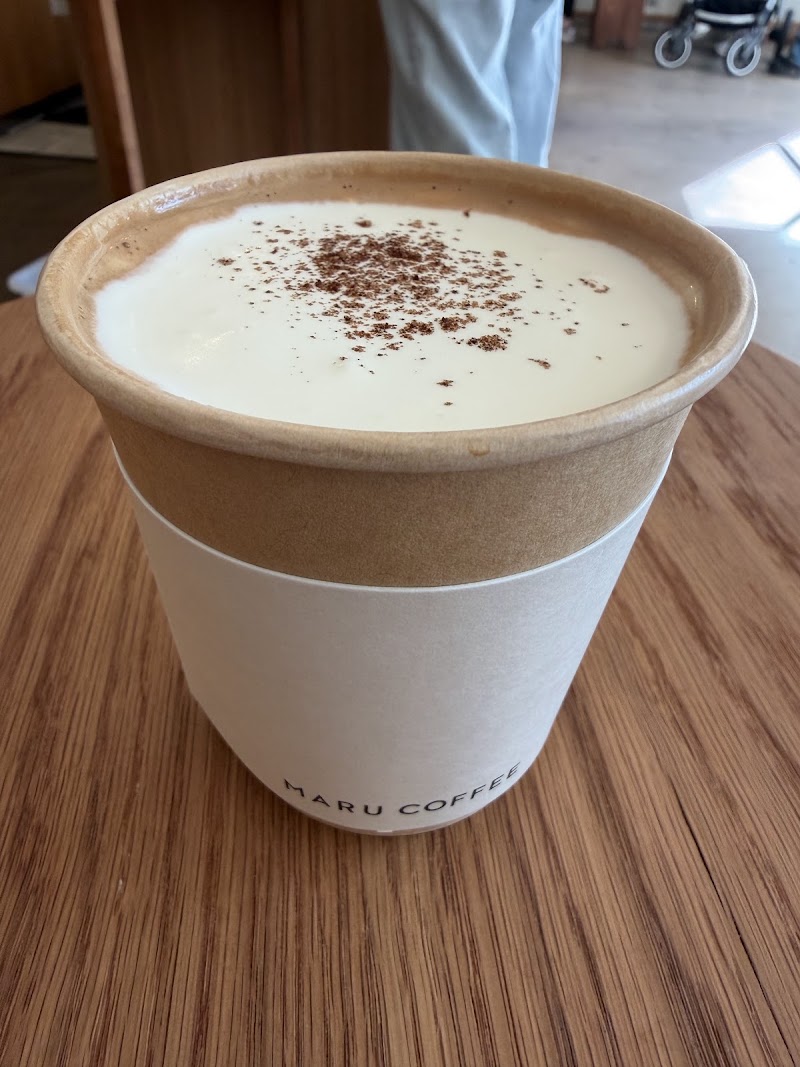
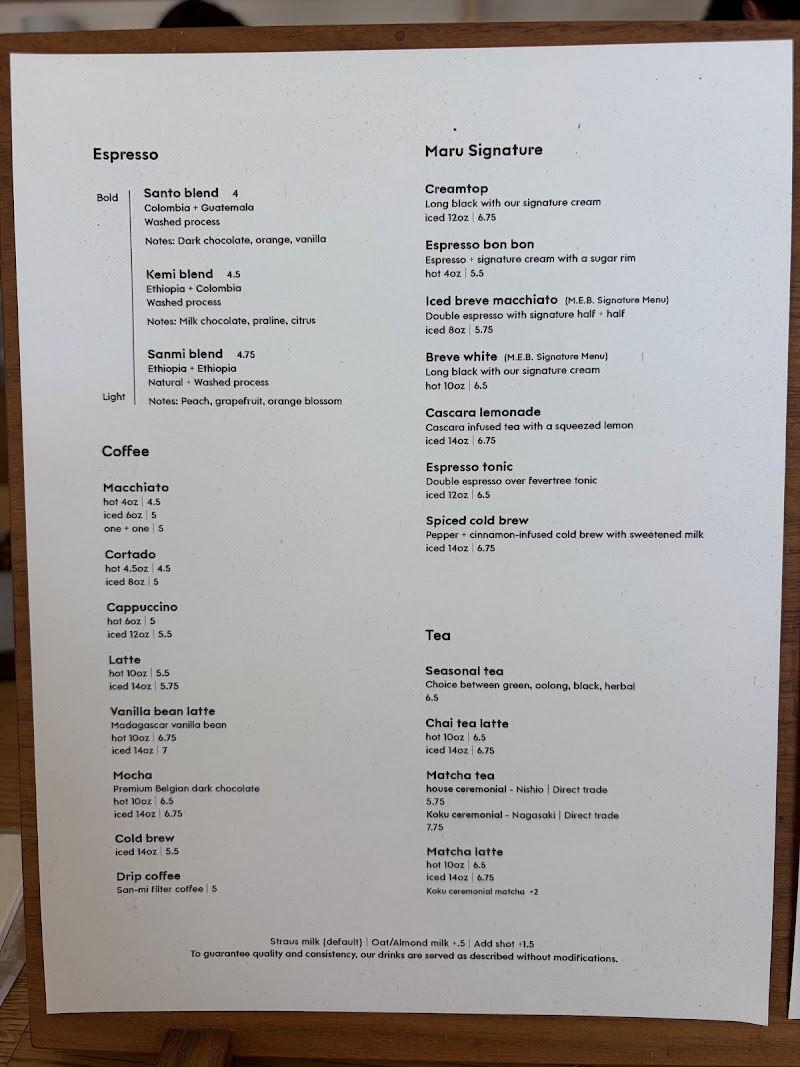
Stylistically the house leans toward clarity rather than heaviness. The milk drinks are the volume orders and they are made to a defined standard rather than improvised, and there is a proper brewed offering for people who want the coffee without dairy in the way. What Maru does not do is theatrics. There is no wall of syrups, no seasonal novelty calendar, no attempt to turn the drink into a dessert. The company’s own language is about ritual and intentionality, and the bar behaves accordingly: fewer options, each of them meant.
Who’s behind it
Maru was started in 2016 by Joonmo Kim and Jacob Park, two friends who met while working behind a coffee counter and decided to open their own. Neither came from design, architecture or hospitality management, and the origin story most often told about them is the furniture: they could not afford — or did not want — to hand the interior to somebody else, so they taught themselves from video tutorials and built it.
That beginning matters because it set the company’s temperament. People who learn a craft by doing it tend to keep doing it, and Maru has since built out the parts of the business that most cafés outsource: the roasting, the design, the wholesale side. The organization now has a head roaster and a lead designer as actual roles rather than as things the owners do on weekends, and it operates rooms in Los Angeles and in New York. The Los Feliz shop is where that entire structure started, which is why it carries a weight the newer, larger rooms do not.
What it’s for
Be honest with yourself about the visit before you come, because this is the single thing people get wrong about Maru. The room is small and the seating is limited on purpose. It is superb for a coffee you drink attentively over twenty or thirty minutes, for meeting one person and actually talking to them, and for the takeaway cup you carry up toward the park. It is not built to host a working session on a laptop for half a day, and the café does not publish any policy about it — the constraint is simply the number of seats and the queue moving behind you at peak.
If a laptop is the point of your visit, the sibling room in the Arts District is the more sensible choice: it is a bigger space with more room to spread out, serving the same coffee. Treat that as the deliberate division of labor between the two. Come to Los Feliz to drink, to look at the room, and to buy beans; go east of downtown when you need a table for hours.
For a solo visit it works very well, provided you accept the format. Nobody performs at you, the service is efficient without being brusque, and a person sitting alone with a cup and a book is exactly the kind of customer the room was drawn for. For a first date it is a strong opener precisely because it is short: one coffee here, then the neighborhood’s shops and the park are right there for the rest of the afternoon.
The space
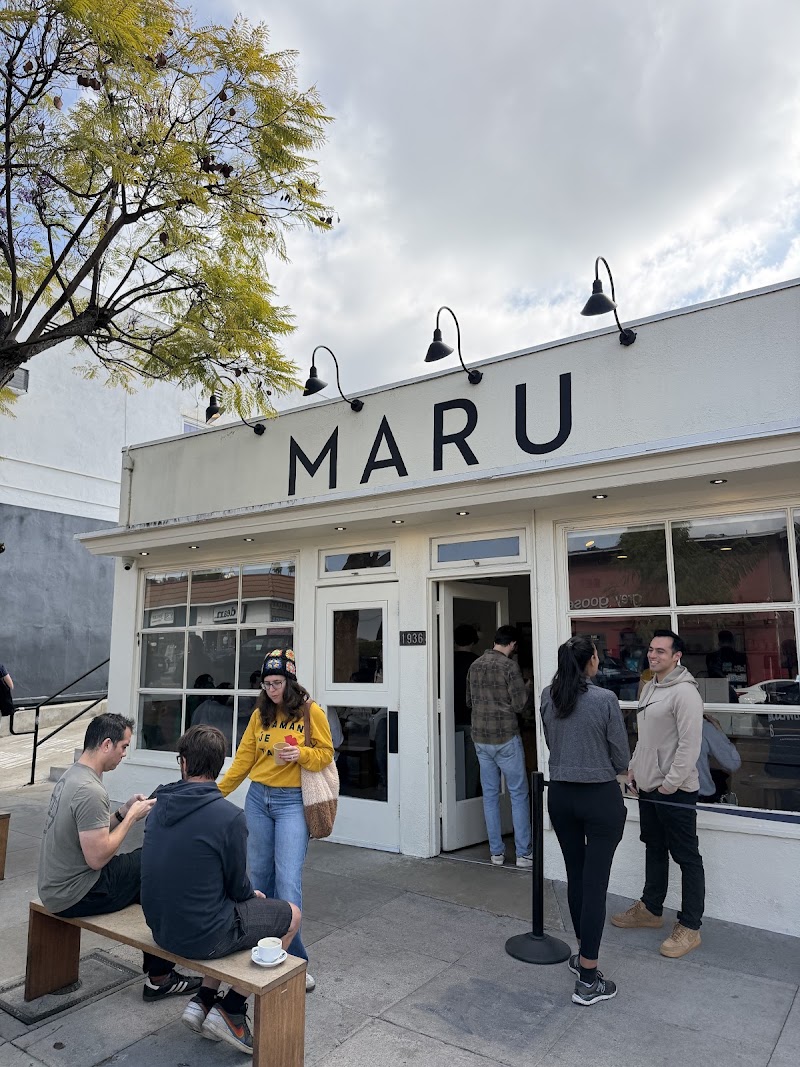
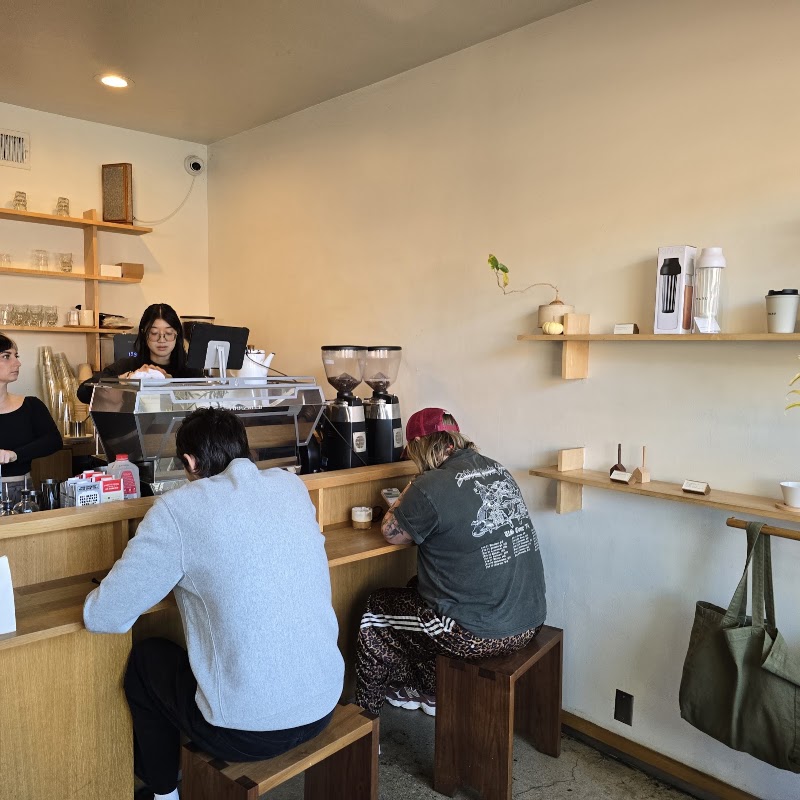
The design press has covered this room more than once, which tells you what it is. Pale timber, clean lines, unpainted surfaces, generous daylight and very little else — the aesthetic is closer to a small gallery than to a coffee shop, and the handmade maple and sycamore pieces are the reason it never tips into feeling sterile. There is a visible difference between a room furnished from a supplier’s catalog and one where somebody cut the joints; this is the second kind.
It is genuinely compact. Counting seats here is an exercise in single digits plus standing room, and on a weekend morning the room fills and the line forms. The noise level is moderate — conversation rather than music-driven — and the acoustics of hard surfaces mean a busy stretch is audibly busy. What the space does exceptionally well is make a cup of coffee feel like an event worth paying attention to, which is not nothing in a city where most coffee is consumed through a car window.
The neighborhood context helps. Los Feliz is a walking pocket in a city that mostly is not one, and the room opens onto a strip where you can leave the café and continue on foot to bookshops, a repertory cinema and a park entrance without moving your car. That makes the small footprint tolerable in a way it would not be in a district with nowhere else to go.
Beyond coffee
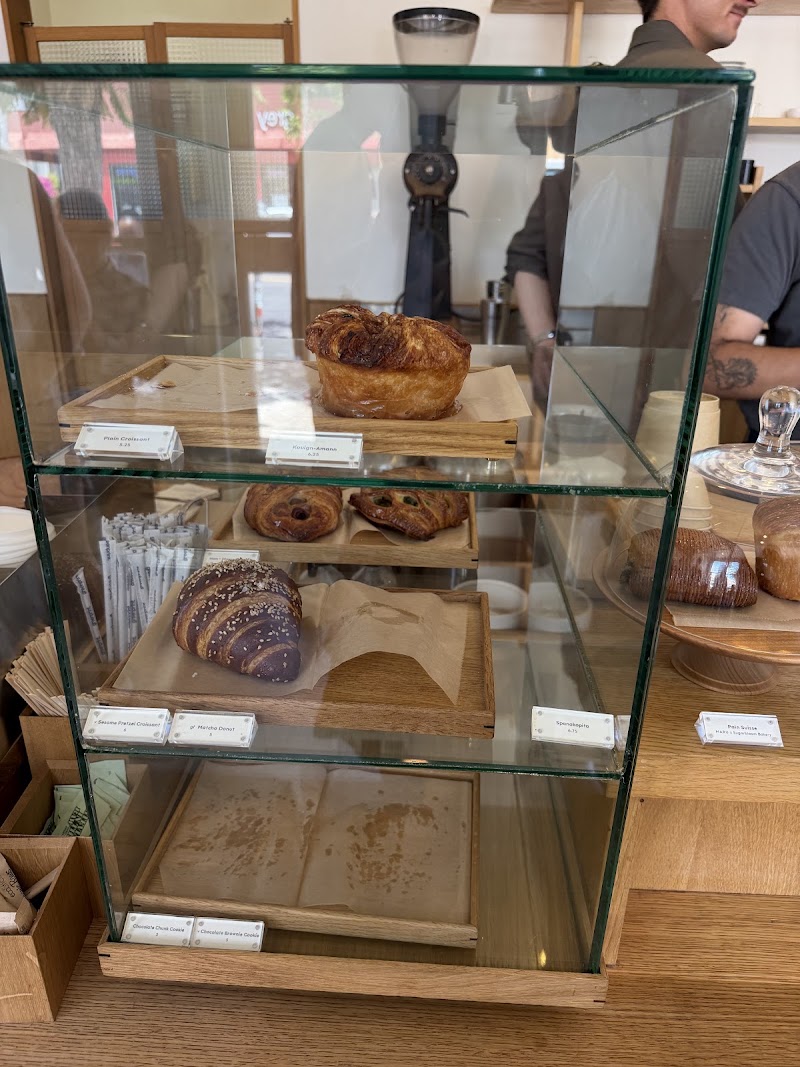
The food side is deliberately minor, and Maru does not pretend otherwise. There is a small selection of baked things at the counter to go with a drink, there is no kitchen behind it, and the company invests essentially none of its storytelling in that side of the counter. Anyone arriving expecting brunch — a real possibility in this neighborhood, where brunch is a competitive sport — will be in the wrong room.
What the counter does sell seriously is coffee to take home. Whole beans from the company’s own roastery are stocked as a matter of course, and the operation runs an online shop as well, so a bag bought here can be repeated without a return trip. Brewing equipment and house goods appear alongside the beans. If you want to understand what Maru actually is, look at the retail shelf rather than the pastry case: this is a roasting business with beautiful shopfronts, and the shopfronts are honest about that.
When to come
The doors open early enough to serve people before the working day, and the shop closes in the afternoon rather than staying on into the evening — this is a daytime café, not a night-time one, and planning an evening meeting here will not work. The heaviest pressure is the weekday morning rush and the weekend late-morning stretch, when Los Feliz fills with people who have walked down from the hills.
The quiet window is the early afternoon on a weekday, and it is a noticeably different room then: seats free, no queue, and staff with time to talk about what is on the brew bar. If the design of the space is part of why you are coming, come then. If you only want the coffee and are happy to carry it out, the peak is no obstacle — the counter is quick.
Getting there
The café sits in the Los Feliz village, the compact commercial strip on the flat below the hills, a few minutes’ walk from the entrance to Griffith Park and close to the Barnsdall Art Park bluff. In a city built around driving, this is one of the genuinely walkable pockets: park once and the rest of the afternoon can be done on foot.
That said, treat parking as the actual journey. Los Angeles is a car city and this strip is one of the busiest short stretches on the east side; the drive here is usually easy and the space at the end of it usually is not. Metered street parking along the village and the residential blocks behind it is the standard solution, with the usual caution about posted restrictions on the side streets. Public transport is a real option but not a fast one: the nearest subway station lies to the southwest, close to a mile away, and the frequent bus lines running along the neighborhood’s main north–south corridor drop you within a block. Rideshare is what most visitors from the west side end up using.
Good to know
Come with the right expectations and Maru is one of the best coffee experiences in Los Angeles; come with the wrong ones and it will feel small and severe. The honest weaknesses are seating and scope. There are few chairs, there is no meaningful food program, and there is nothing on the menu designed to entertain a guest who does not care about coffee. A group of four will struggle to sit together at a busy hour.
Two practical notes. First, the company has grown, so if you have visited a Maru elsewhere and remember it as roomy, that was one of the newer rooms — this one is the original and the smallest. Second, because this is a roastery-owned café, questions about origin, process and roast date get real answers here; it is worth asking rather than pointing at the board.
Questions and answers
Does Maru roast its own coffee?
Yes. The company runs its own roastery in Glassell Park, in a building that previously served as Intelligentsia’s West Coast roasting facility, and everything poured in the cafés comes from there.
Who founded it, and when?
Joonmo Kim and Jacob Park, who met working at a coffee shop, opened the first Maru in Los Feliz in 2016.
Can I work here with a laptop?
Not for long. The room is small and the seating is limited, so a short stop works and a half-day session does not. The company’s larger Arts District café is the better choice for that, with the same coffee.
What does the name mean?
It comes from Korean and carries the sense of a mountaintop or ridge — a reference both to the founders’ heritage and to the high-altitude origins of good coffee.
Is there food?
Only a small counter selection of baked things to accompany a drink. There is no kitchen and no brunch; if you want a meal, eat elsewhere in the neighborhood and come here for the coffee.
How many locations are there?
Beyond this original Los Feliz room, Maru operates a café in the Arts District, an espresso bar in Beverly Hills, and a room in Williamsburg, Brooklyn — the first outside California.
Can I buy beans to take home?
Yes, whole beans from the company’s own roastery are stocked at the counter, and the same coffees are sold through the company’s online shop.
Is it easy to park?
Getting here by car is simple; parking is the hard part. The Los Feliz strip is busy and metered, so allow extra time, or use the buses along the neighborhood’s main corridor.
Is it good for a group?
Not really. Two people are comfortable, four are a stretch at a busy hour. For a group, plan on takeaway cups and the park a few minutes away.
Opening hours
| Day | Hours |
|---|---|
| Monday | 07:00–17:00 |
| Tuesday | 07:00–17:00 |
| Wednesday | 07:00–17:00 |
| Thursday | 07:00–17:00 |
| Friday | 07:00–17:00 |
| Saturday | 07:00–17:00 |
| Sunday | 08:00–17:00 |
Photos
Visitor reviews
Reviews last updated: 2026-08-10 15:37:20
Data is refreshed monthly. Sources: losangeleska.com and editorial picks based on reviews.
Кава була справді смачною, пончик з кавовим тістечком був чудовим. Хлопець у ресторані дав кілька рекомендацій, які я оцінив якраз для свого першого разу. Заклад справді маленький, тому не сподівайтеся сидіти всередині.…
ТАК ПЕРЕПОВНЕНО навіть у будній день! Але вони швидко проходять чергу, чекати на напій потрібно близько 30 хвилин, коли все переповнено, а хтось вкрав мій, тому вони швидко його приготували, коли я їм повідомив, вони бул…
Я постійно сюди ходжу, і це мій перший відгук — настільки серйозна ця кава. Це місце має фірмовий смак, який ви не знайдете більше ніде в Лос-Анджелесі.
Цукерка та вершковий верх культові — насичений, ніжний, ідеально зб…
Кав'ярня Maru – насолода в серці Лос-Феліз
Кав'ярня Maru в Лос-Феліз – справжня перлина для любителів кави. Щойно ви зайдете всередину, вас зустріне мінімалістична, але водночас приваблива атмосфера. Поєднання дерев'яни…
Гарно. Дуже типова кав'ярня для білих дівчат.
Однозначно модний центр Лос-Анджелеса.
Наступного разу хотілося б спробувати більше кави, окрім лате з льодом.