

Barbara Kruger is one of the most influential figures in contemporary conceptual art. Her work has radically reshaped how we understand the interplay between text and image. Her art is instantly recognizable worldwide, thanks to its striking contrast of black-and-white photographs paired with provocative white text on bold red backgrounds. Kruger is a key member of the Pictures Generation, an art movement that explored how mass media shapes human consciousness. Read more on losangeleska.
Kruger works at the intersection of art, design, and social critique. Her pieces tackle heavy themes like power, identity, consumerism, and gender. In 2021, the artist was named one of TIME magazine’s 100 most influential people. This honor highlights the massive scale of her cultural impact.
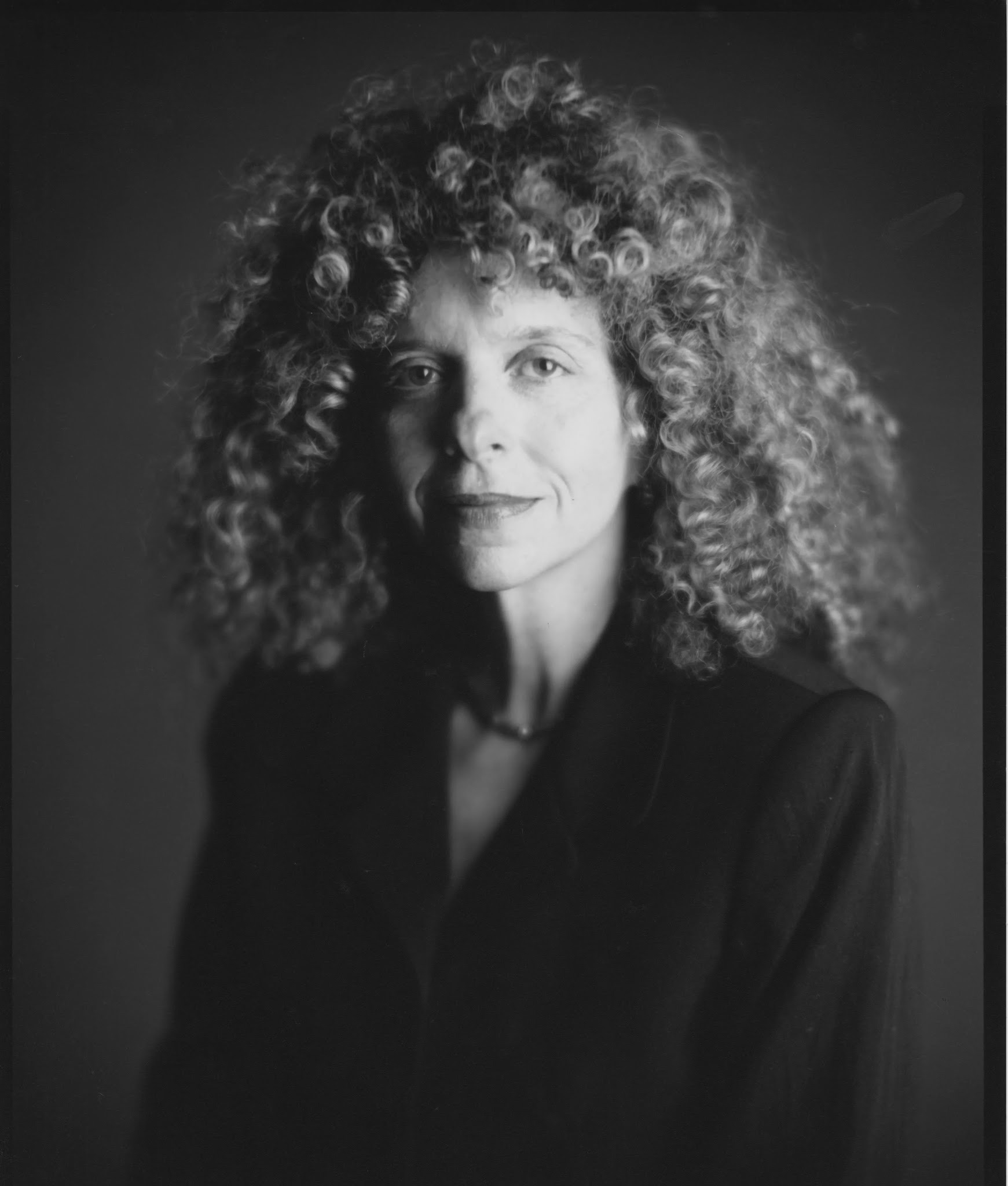
Biography
Barbara Kruger was born on January 26, 1945, in Newark, New Jersey, into a working-class family. Her father worked as a chemical technician, and her mother was a legal secretary. After high school, she attended Syracuse University but had to drop out following her father’s death. In 1965, Kruger enrolled at the Parsons School of Design in New York City. There, she studied under renowned artists like Diane Arbus and Marvin Israel. This dynamic environment deeply shaped her understanding of visual culture.
Kruger’s early career was closely tied to the media industry. She worked as a designer for “Mademoiselle” magazine and collaborated with the publishing powerhouse Condé Nast.
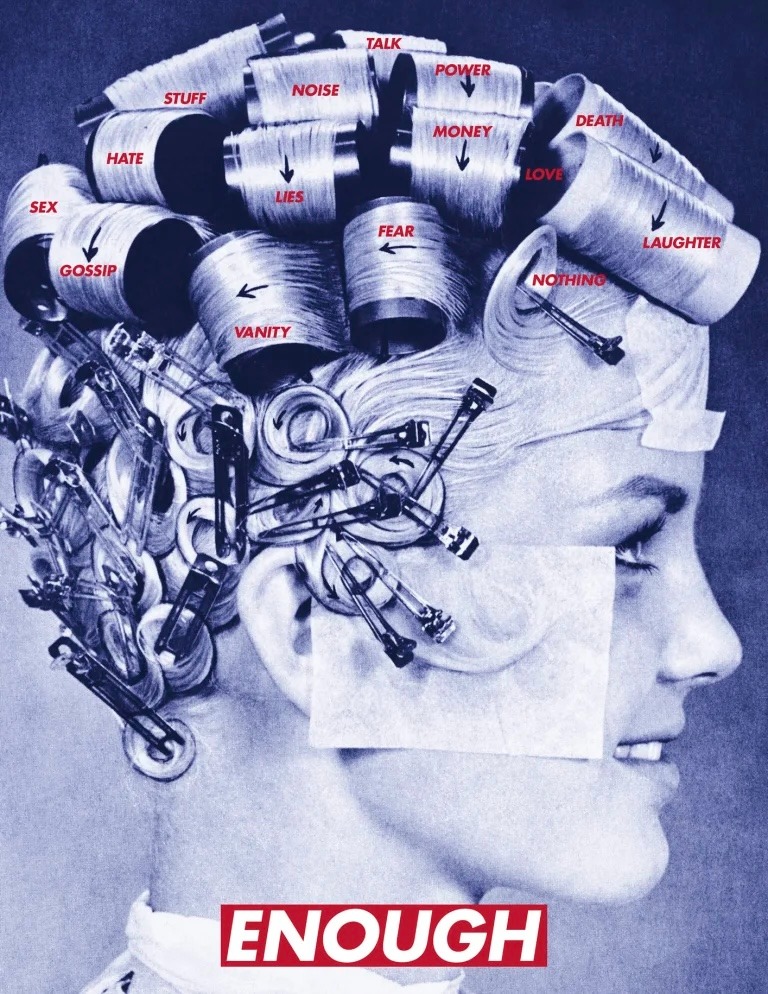
Conceptual Art
In the late 1960s, Kruger developed an interest in poetry and soon began experimenting with various art forms. Her early works featured textile compositions using yarn, beads, and fabric. These pieces reflected the growing feminist trends of the era.
During the 1970s, the artist went through a creative crisis and temporarily stepped away from the art world. After moving to California, she started teaching at the university level. During this time, she became fascinated by the ideas of Walter Benjamin and Roland Barthes. Their theories on language, signs, and meaning heavily influenced her future style. When she returned to making art in the late 1970s, Kruger began merging photography with text. This specific approach became the foundation of her signature aesthetic.
A Unique Artistic Language
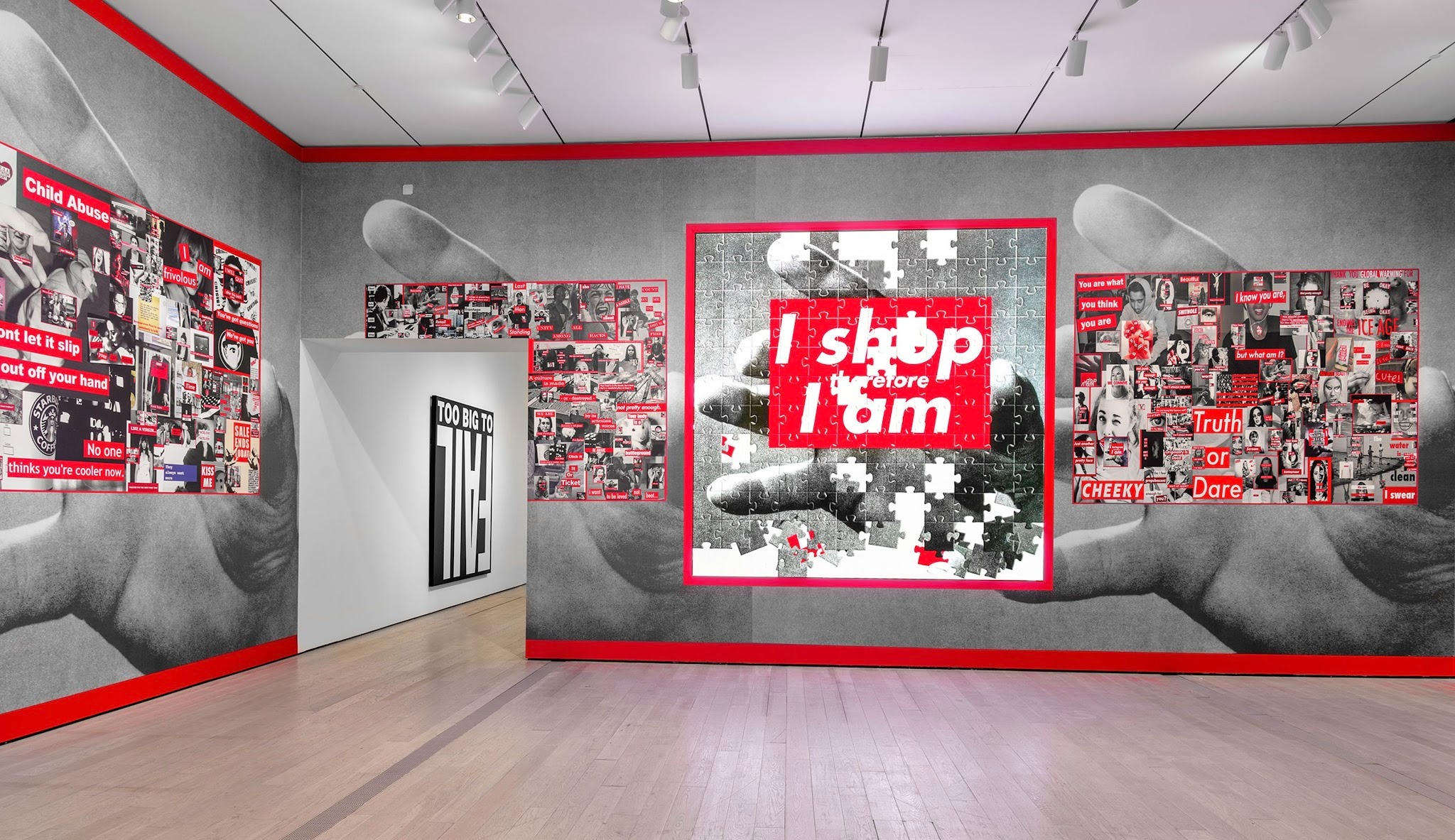
The defining feature of Barbara Kruger’s work is her pairing of found photographs with short, punchy text. Phrases like “I shop therefore I am,” “Your body is a battleground,” and “You are not yourself” have achieved cult status. By using pronouns like “you,” “we,” and “they,” she speaks directly to the viewer. She forces us to think about how identity is manufactured in a world saturated with advertising and media. Kruger works across a variety of mediums, including photography, installation, video, architecture, and graphic design. Her pieces are often scaled up to billboard size and displayed in public spaces. This ensures her art is highly accessible to a broad audience.
Kruger’s art is inextricably linked to feminist discourse. She consistently explores issues of bodily autonomy, gender inequality, and societal roles. One of her most famous posters, “Your body is a battleground,” was originally created for a major women’s rights march in Washington, D.C. The artist is also a fierce critic of consumer culture. Her work highlights how advertising manufactures desire and manipulates the human mind. She borrows the exact visual tricks used in marketing but flips the script, filling them with subversive meaning.
Large-Scale Projects
Kruger is celebrated for her massive projects in public spaces. She has collaborated with museums, transformed public transit systems, and integrated her art into architectural landmarks.
Some of her most notable works include:
- the “Belief+Doubt” installation at the Hirshhorn Museum and Sculpture Garden;
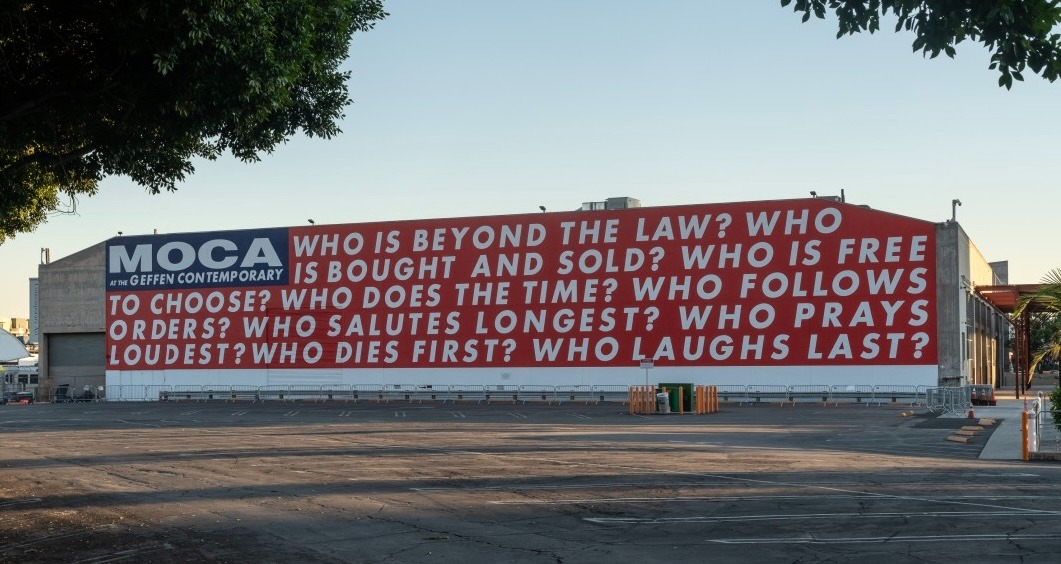
- various projects for the Museum of Contemporary Art, Los Angeles (MOCA);
- exhibitions at the Venice Biennale.
In Los Angeles, Kruger frequently turned the urban landscape into a platform for dialogue with the public. One of her standout efforts was her collaboration with MOCA, where she spearheaded massive ad campaigns to bring art to the masses. For a major retrospective, she created a series of billboards and street posters in both English and Spanish. These were plastered all across the city. Her public transit project also drew significant attention. Kruger wrapped city buses in bold phrases like “You want it. You buy it. You forget it,” highlighting the endless cycle of consumerism. These pieces perfectly integrated art into the daily lives of Angelenos. Her iconic mural Untitled (Questions), created for MOCA, became a true symbol of the city’s art scene. The piece features a series of probing questions about power, the law, and freedom—issues that remain incredibly relevant today. On top of that, Kruger has created immersive installations in local museums. At the Hammer Museum, for example, she completely transformed the space, redefining how viewers interact with text and their environment.
Kruger has regularly partnered with top-tier art institutions in Los Angeles, including the Los Angeles County Museum of Art (LACMA). She has participated in various exhibitions and designed site-specific installations there. In 2022, her major retrospective, “Thinking of You. I Mean Me. I Mean You,” traveled to LACMA after its run in Chicago. This show truly highlighted the incredible scope of her work, spanning from early paste-up collages to cutting-edge digital installations.
The artist also took part in the Frieze Los Angeles international art fair. For this event, she displayed a series of 20 questions on billboards, banners, and digital screens scattered throughout the city.
For Barbara Kruger, Los Angeles isn’t just a place to live; it’s a laboratory for ideas. It was here that her work achieved its maximum public reach and social impact. She managed to break out of the traditional gallery walls and speak directly to everyday people—on the streets, on their daily commute, and in their neighborhoods.
Teaching Career
Kruger spent many years teaching at some of America’s top universities. Notably, she earned the title of Distinguished Professor at the University of California, Los Angeles (UCLA). Her curriculum focused heavily on new media, critical thinking, and the deep analysis of visual culture. She didn’t just influence her students as a working artist, but also as a cultural theorist breaking down the power dynamics hidden within images and texts. Her influence can be traced in the work of many acclaimed artists, including Cindy Sherman and Jenny Holzer, who also tackle themes of media and identity.
Kruger has received numerous awards, including the Golden Lion for Lifetime Achievement at the Venice Biennale. Her pieces are displayed in major museums across the globe, and her signature style has profoundly influenced the worlds of fashion and branding. In fact, her aesthetic is so iconic that the streetwear brand Supreme essentially co-opted her visual language for its own logo. This borrowing has sparked endless discussions within the art community.
Ultimately, Barbara Kruger is an artist who transformed language into a sharp tool for both art and cultural critique. Her pieces are never just visual objects; they are powerful statements about the modern world. She forces her audience to do more than just look. She challenges us to think, to question, and to completely reimagine our reality. Her work remains as relevant as ever because the issues of power, identity, and media influence have only grown more urgent. Kruger has definitively proven that art can be just as intellectually and socially vital as it is visually striking.